
 All Caps
 ScopeCaps
 LightCaps
 Red Dot Caps
 Night Vision Caps
 Thermal Caps
 Specialty Caps
 Lights
 Red Dots/HWS
 Magnified Optics
 Lasers
 Slings
 Night Vision Devices
 Thermal
 Helmets
 Accessories
 Camouflage
 Water
 Faraday
 EDC
 Apparel
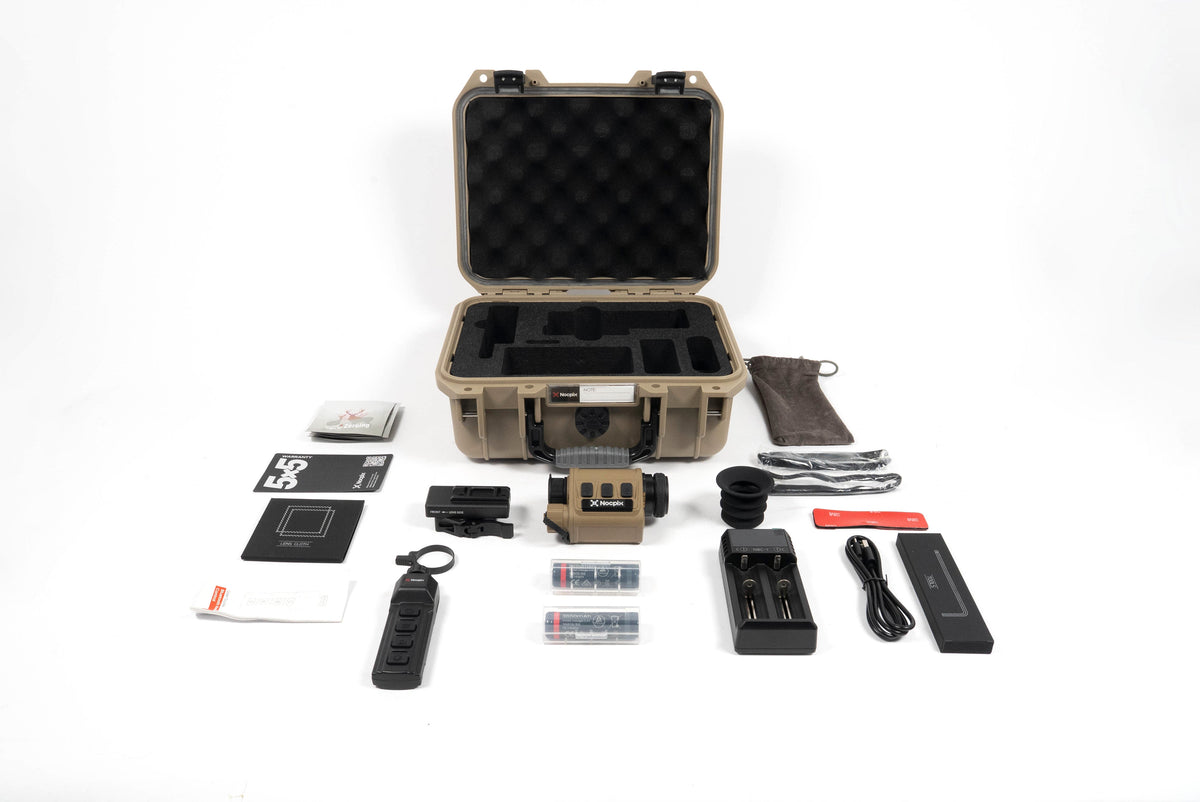
iRay RH25 vs NOCPIX MICRO2: How to Choose
If you are trying to pick a compact thermal that can do more than one job, you have probably already bumped into the same three names: the iRay RH25, the NOCPIX MICRO2 H25, and the NOCPIX MICRO2 Ultra S25. Each one can work as a handheld scanner, a helmet monocular, a clip-on, or a dedicated weapon sight. The useful differences come down to sensor resolution, field of view, how you plan to mount it, and how long you need it to run on one battery.
The iRay RH25 V2 is discontinued, though the product page on One Hundred Concepts is still up if you already own one or need accessory details. For a current unit in that same multi-role class, the store points you to the NOCPIX MICRO2 H25 and the NOCPIX MICRO2 Ultra S25. This guide covers what they share, where they diverge, and which one fits how you actually hunt, scan, and mount.
Our pick: If you want the absolute best, most cutting-edge 4-in-1 thermal for the money among these options, go with the MICRO2 Ultra S25. The 1280×960 sensor, much wider field of view, and ≤15 mK sensitivity put it ahead of the pack, and it is the recommendation we give when someone asks for the top choice.
What a 4-in-1 thermal is built to do
A dedicated thermal weapon sight lives on a rifle. A handheld is for scanning from a bag or a pocket. A helmet-mounted monocular sits on your head so you can move while you look. A clip-on goes in front of a day optic so you keep your familiar reticle and zero. A 4-in-1 like the RH25 or a MICRO2 tries to cover those jobs in one magnesium housing, which is handy when you want one optic that can move from rifle to helmet to hand as the night changes.
That flexibility is also why the choice gets personal. Helmet time puts a premium on weight and field of view. Clip-on use cares about how much day magnification the thermal can support. Running it as a dedicated sight leans on display clarity and how the image feels when you move the rifle. Figure out the job you will run most often, then look at the specs that support it.
Specs that actually matter when you choose
Shopping pages throw a lot of numbers at you. A handful of them change how the optic feels in the field. The rest can wait until you know what you are solving for.
Sensor resolution is how many pixels build the heat picture. More pixels can mean more detail, especially when you digital-zoom. The RH25 and MICRO2 H25 sit in the 640-class range (640×480 and 640×512). The Ultra steps up to 1280×960, which is four times the pixel count of a classic 640×480.
Pixel pitch (12 µm on all three) is the size of each detector element. Together with the lens, it helps set field of view. These three share the same 12 µm pitch and the same 25 mm f/1.0 objective class, so FOV and detail differences come mainly from sensor size and how you use the optic. NETD / thermal sensitivity describes how small a temperature difference the sensor can resolve; lower is generally better. The MICRO2 H25 and Ultra both list NETD at ≤15 mK.
Field of view is how much of the world you see at once. Wider FOV helps helmet scanning; a tighter FOV can feel more aimed on a rifle. The RH25 and H25 share a 17.5° × 13.1° FOV. The Ultra opens that up to 34.2° × 25.9°. Display is what your eye looks at: the RH25 uses a 1440×1080 AMOLED, while both MICRO2 models move to a 2560×2560 AMOLED class display (the H25 lists a 1.03-inch panel).
All three support clip-on, dedicated sight, helmet, and handheld roles. Clip-on day-optic support goes up to 6× on the RH25 and up to 10× on both MICRO2 models. Digital zoom goes to 4× on the RH25 and H25, and up to 8× on the Ultra. Power is a hot-swappable 18650 with USB-C external support. In power-saving mode, the H25 is rated up to about 9 hours per battery, and the Ultra up to about 6 hours.
Side-by-side comparison
Here is the same picture in one place, with plain-language labels for the numbers that change how you choose.
| What you are comparing | iRay RH25 V2 | NOCPIX MICRO2 H25 | NOCPIX MICRO2 Ultra S25 |
|---|---|---|---|
| Primary roles | Handheld, helmet, clip-on, weapon sight | Handheld, helmet, clip-on, weapon sight | Handheld, helmet, clip-on, weapon sight |
| Thermal sensor | 640×480, 12 µm | 640×512, 12 µm | 1280×960, 12 µm |
| Refresh rate | 60 Hz | 60 Hz | 60 Hz |
| Thermal sensitivity (NETD) | n/a | ≤15 mK | ≤15 mK |
| Objective lens | 25 mm f/1.0 | 25 mm f/1.0 | 25 mm f/1.0 |
| Field of view | 17.5° × 13.1° | 17.5° × 13.1° | 34.2° × 25.9° |
| Display | 1440×1080 AMOLED | 1.03-inch 2560×2560 AMOLED | 2560×2560 AMOLED |
| Clip-on day-optic support | Up to 6× | Up to 10× | Up to 10× |
| Digital zoom | 4× | Up to 4× | Up to 8× |
| Onboard storage | 64 GB | 64 GB | 64 GB |
| Power | 18650 (USB-C external supported) | 18650 (USB-C external supported) | 18650 (USB-C external supported) |
| Power-saving runtime | n/a | Up to about 9 hours | Up to about 6 hours |
| Weight | 11.3 oz | 11.2 oz | 12.9 oz |
| Housing / weather sealing | Magnesium, IP67 | Magnesium alloy, IP67 | Magnesium alloy, IP67 |
iRay RH25 V2: the baseline a lot of people already know
The RH25 earned its reputation as a compact multi-role thermal in a magnesium housing. It was small enough for a helmet or the hand, and capable enough to clip in front of a day optic or sit as a dedicated sight. For a lot of shooters, it was the first optic that made “one thermal, several jobs” feel realistic.
On the specs that matter here, the V2 used a 640×480, 12 µm sensor, a 1440×1080 AMOLED display, a 25 mm f/1.0 objective, a 17.5° × 13.1° field of view, clip-on support up to 6×, 64 GB of storage, and a hot-swappable 18650. At 11.3 oz with IP67 sealing, it set a useful standard for micro 4-in-1 thermals. It is discontinued now. The RH25 product page stays live on One Hundred Concepts for owners and for anyone comparing accessories or the older platform’s specs. If you are buying new in this role today, the current path is the MICRO2 lineup.
NOCPIX MICRO2 H25: a solid continuity pick
If you liked the RH25’s size and field of view and want the current NOCPIX 4-in-1 platform without stepping up to the Ultra’s wider picture, the MICRO2 H25 is a strong continuity choice. It keeps the same 17.5° × 13.1° FOV and a 640-class sensor (now 640×512), while moving to a much higher-resolution 2560×2560 AMOLED display.
Compared with the RH25, you also get clip-on support out to 10× day optics, Dual-Link for pairing two units, dedicated NV-oriented display modes for dual-band setups, and up to about 9 hours in power-saving mode on one 18650. Weight stays near 11.2 oz. That longer runtime and familiar viewing angle make the H25 a genuinely good fit if helmet time and battery life matter more to you than maximum resolution and FOV.
NOCPIX MICRO2 Ultra S25: our pick for the best 4-in-1 thermal
The MICRO2 Ultra S25 keeps the same 4-in-1 role set and steps the sensor to 1280×960 with a much wider 34.2° × 25.9° field of view. Digital zoom goes up to 8×, clip-on support matches the H25 at up to 10×, and the display stays in that 2560×2560 AMOLED class. Weight is listed at 12.9 oz, and power-saving runtime is up to about 6 hours per 18650. Sensitivity is ≤15 mK, same class as the H25.
If you want the absolute best and most cutting-edge option in this micro 4-in-1 set for the money, the Ultra S25 is the way to go. That is our clear pick. The jump to 1280×960, the much wider FOV, up to 8× digital zoom, and that ≤15 mK NETD give you the most capable picture and the most flexible scanning view of the three. It is aimed at helmet and scanning-forward setups where seeing more of the scene (and having more pixels when you zoom) matters more than matching the H25’s longer runtime. When someone asks us for the top choice among these platforms, this is the one we point them to.
Which one is right for you?
If you want the absolute best, most cutting-edge 4-in-1 thermal for the money, choose the MICRO2 Ultra S25. That is our recommendation: higher resolution, a much wider field of view, strong ≤15 mK sensitivity, and up to 8× digital zoom in the same multi-role package.
Prefer longer runtime in power-saving mode, a familiar 17.5° FOV, and a lighter 640-class setup? The MICRO2 H25 is still a solid choice, and it remains the better match for that specific list of priorities. Already own an RH25? The product page is still available for accessories and specs, even though new RH25 V2 units are discontinued.
Plan the rest of the system too. Mounts, dual-band night vision pairings, spare 18650s, and lens protection matter as much as the sensor on the box. For covers, see the ThermalCap. It is sold as a custom fit to listed devices, so confirm the device option before you assume an RH25 cover will fit a MICRO2 housing. When you are ready to compare live availability and included mounts, browse the thermal devices collection.
Frequently asked questions
Is the RH25 coming back?
On One Hundred Concepts, the RH25 V2 is listed as discontinued, and the product page directs shoppers toward the MICRO2 H25 and MICRO2 Ultra S25. There is no published restock or return date beyond that on-page status.
What is the main difference between the MICRO2 H25 and the Ultra S25?
Both are 4-in-1 thermals with 2560×2560-class AMOLED displays, clip-on support up to 10×, 18650 power, and IP67 magnesium-alloy housings. The H25 uses a 640×512 sensor, a 17.5° × 13.1° FOV, and about 9 hours of power-saving runtime. The Ultra uses a 1280×960 sensor, a 34.2° × 25.9° FOV, up to 8× digital zoom, 12.9 oz listed weight (vs 11.2 oz), and about 6 hours of power-saving runtime. For the most capable picture and widest view, we pick the Ultra.
Will my RH25 ThermalCap fit a MICRO2?
ThermalCap is custom-fit. The ThermalCap product currently lists device options for RH25/RH25-V2 (and StingIR). A MICRO2 housing is not listed there as of this writing, so do not assume fit. Check the ThermalCap page for current options before ordering.
Do I need thermal, night vision, or both?
They solve different problems. Thermal is strong for spotting heat contrast; night vision gives more visual context of the terrain. If you are still deciding which technology fits the job, read our guide on choosing between night vision and thermal optics. For protecting glass once you have picked a platform, see what actually damages optics in the field.
Compare the platforms
- iRay RH25 V2 (discontinued; page stays live)
- NOCPIX MICRO2 H25
- NOCPIX MICRO2 Ultra S25 (our pick)
- ThermalCap (custom-fit lens cover)
- Thermal devices collection

Leave a comment
This site is protected by hCaptcha and the hCaptcha Privacy Policy and Terms of Service apply.