 All Caps
 ScopeCaps
 LightCaps
 Red Dot Caps
 Night Vision Caps
 Thermal Caps
 Specialty Caps
 Lights
 Red Dots/HWS
 Magnified Optics
 Lasers
 Slings
 Night Vision Devices
 Thermal
 Helmets
 Accessories
 Camouflage
 Water
Water
 Faraday
 EDC
EDC
 Apparel
Article: Kit Blog Vol 1 | Chris’ Brain Bucket
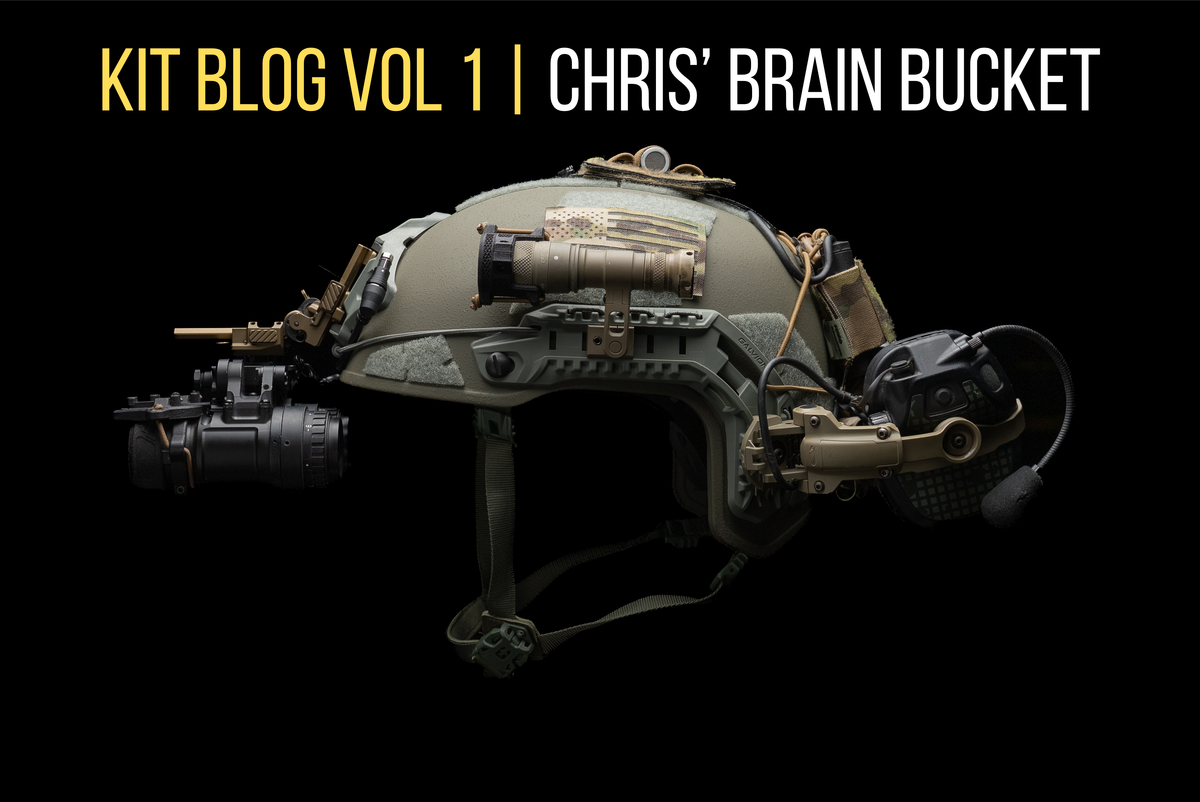
Kit Blog Vol 1 | Chris’ Brain Bucket
Published: Jan 6, 2026
Setup Philosophy and Intent
As a civilian, I approach helmet setups with a simple philosophy: only mount what is absolutely necessary and nothing more. It is common to see SOF operators running battle-worn helmets covered in accessories, but those configurations exist to support specific missions, roles, and team-based requirements that extend far beyond simply mounting night vision.
For most civilians, a helmet serves a much simpler role. Its primary purpose is to securely and comfortably support a night vision device. With that in mind, simplicity becomes the priority. Reducing unnecessary weight improves comfort during extended use while also streamlining the system, making it easier to manage and more reliable when it matters.
This helmet configuration is the result of extensive time spent under night vision in both training and hunting environments. Every component, as well as every deliberate omission, is informed by real-world experience rather than appearance.
 The Helmet
The helmet pictured is a Galvion Caiman TL ballistic helmet. This is a relatively uncommon option in the U.S. market, which is largely dominated by Gentex and Team Wendy. The Caiman stands out due to its extremely lightweight design and, in my opinion, some of the best stock pads currently available.
When evaluating comfort, protection level, weight, and fit, the Caiman performs exceptionally well. The retention system is an in-house design from Galvion that closely mirrors the Team Wendy BOA system. While the BOA remains the benchmark, this system is a close runner-up. It uses a dial to adjust suspension tension and provides a secure, consistent fit.
The helmet is rated to NIJ IIIA+ standards and is capable of stopping most common pistol rounds and fragmentation.
Nocturn Industries Alpha Mount
The night vision mount featured is the Nocturn Industries Alpha Mount. This mount is notable primarily for its significant weight savings. The Alpha Mount weighs just 80 grams, compared to 166 grams for the Wilcox G24 and 167 grams for the Cadex.

The Alpha Mount represents a departure from legacy mounting solutions that have dominated the industry for decades. One of its defining features is the ability to remove the deploy button and switch to a force-to-overcome design. This feature was the primary factor that drew me to the mount, as it allows for extremely fast deployment and stowing of night vision. This capability is particularly useful when switching between night vision devices and a dedicated thermal optic.
While not a mandatory upgrade, the Alpha Mount is a strong option for anyone looking to move toward a lighter, more modern mounting solution.

The Night Vision
I am running the Low Light Innovations MH-1s for night vision. After several years of use, they have proven to be a feature-rich and reliable option. The MH-1s are a magnesium alloy articulating housing equipped with manual gain control and dual onboard IR illuminators.

Paired with RPO 4.0 optics, the MH-1s are likely the lightest metal night vision housings currently available. When combined with the Alpha Mount, the total system weight is 19.59 ounces or 555 grams which is less than some metal housings not even including a mount.
Internally, the unit is equipped with L3 white phosphor tubes, which have consistently performed well over time. The MH-1 housing continues to stand out for its durability and quality-of-life features, making it a strong recommendation for those seeking a lightweight metal housing.
Accessory Rails and Mounts
The Galvion Caiman accessory rail follows an ARC-rail-like design similar to what is used by Gentex, allowing compatibility with the majority of headborne accessories on the market. I initially had concerns about compatibility with Ops-Core AMP arms but found that they fit without issue.

A standardized rail system significantly reduces frustration when mounting critical accessories. This was one of my primary issues with my previous Team Wendy bump helmet, and the Caiman resolves it entirely.
Additional Accessories
On the left side of the helmet, I run a SureFire Vampire Mini equipped with a One Hundred Concepts Admin Cap. The Admin Cap gives you the ability to have both a full power and admin capability to the light, doubling the functionality of the SureFire Vampire. It is mounted using an S&S Precision M-Ax mount, which provides full swivel capability. This setup offers both white light and IR illumination in an easily accessible position.

The swivel mount allows precise articulation of the light while also enabling it to be rotated straight up to flood a room with illumination, commonly referred to as “umbrella lighting.”
For hearing protection, I use Ops-Core AMPs paired with AMP arms. These are my preferred helmet-mounted ear protection due to their excellent sound directionality and effective noise reduction. While not without flaws, they have performed reliably across a wide range of use cases.

For counterweight, I use an Ops-Core slim counterweight pouch with a Ferro Concepts battery pack pouch mounted above it. A counterweight is one of the most important components for long-term comfort when running a headborne system. The neck fatigues quickly under an unbalanced load, making proper weight distribution critical.

A balanced helmet also works in conjunction with the AMP arms and suspension system to improve overall stability during extended use.
Inside the battery pack, I run a Low Light Innovations battery pack loaded with four AA lithium batteries. This pack can serve as an external power source for the night vision unit. At present, I am running a single CR123A in the onboard battery compartment but plan to transition to the Low Light Innovations Universal Battery Compartment in the future.
Not pictured on the helmet is a Unity Spark IR marker. As a civilian, an IR marker is on the bottom of my priority list. We all want to run around with a Helstar strobe, but the reality is that it is unnecessary weight and likely more of a liability. I usually keep the Unity marker in a pouch and attach it to the helmet only when necessary.

Retention
Retention is one of the most critical elements of any helmet-mounted night vision setup. A secure retention system prevents costly damage caused by drops from poor mounting solutions or environmental snags.

My retention solution of choice is the Knocker Cable from 1350 Mill Works. This system uses a 90-pound test steel cable with a split ring on one end and a mini wire gate on the other, which attaches directly to the night vision device.
The goal was to avoid cluttered retention systems that create tangles and unnecessary complexity. The Knocker Cable offers a clean, simple solution that is easy to install and remove. While some users prefer multiple lanyards for redundancy, I find a single, well-designed retention point sufficient for my needs.
Performance in the Field
This helmet setup is still relatively new, and I do not yet have the same number of hours on the Caiman as I did on my previous Team Wendy bump helmet. However, after multiple night hunts and training sessions, the Caiman has proven to be very comfortable, even when running the stock pads.
While the 4D Tactical HYVE pads in the bump helmet set a high bar, the Caiman’s stock pads have performed well so far. As expected, the ballistic helmet is heavier than a bump helmet, but the Caiman remains impressively light at 2.71 pounds for a size XL.
The helmet also balances better overall, which has reduced the amount of counterweight required compared to my previous setup.
Final Thoughts
This helmet build reflects a deliberate, experience-driven approach to equipment selection. Every component serves a clear purpose, and anything that does not directly contribute to performance or comfort has been intentionally left out.
There is no universal solution when it comes to helmet setups. Equipment should evolve alongside experience, environment, and intended use. What matters most is understanding why each component is included and how it supports real-world application.
Ultimately, the most effective helmet system is one that remains comfortable over long periods, functions reliably, and stays out of the way when it counts. This build accomplishes exactly that.
Written by Chris Fischle
Stay Dangerous. Always.